The Skin–Brain–Emotion Connection: What Neuroscience (and the Beauty Industry) Is Finally Catching Up To
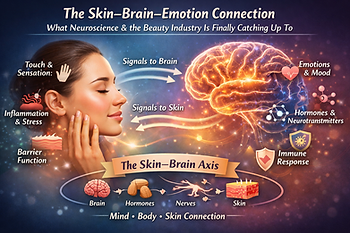
If you’ve ever broken out before a big event, flushed during an awkward moment, or felt itchy when you’re anxious, you already know the truth: skin is not just a “surface.” It’s a sensory organ wired to your nervous system, soaked in stress hormones, and in constant conversation with your immune system.
Neuroscience and dermatology increasingly describe this as a bidirectional skin–brain axis: your emotions and nervous system influence the skin, and signals from the skin (inflammation, itch, pain, sensation, even social feedback) influence the brain. Recent reviews synthesize this as an integrated network involving the brain + pituitary + adrenal glands, peripheral nerves, immune pathways, and skin cells, all exchanging chemical “messages” called neuromediators. PubMed Central+1
And here’s the headline the beauty world is acting on: neuromediators can exercise direct influence over both our skin and our emotions. That’s the scientific doorway behind the surge in “neurocosmetics,” “emotional skincare,” and sensorial wellness beauty.
Let’s unpack what’s real, what’s promising, and what’s mostly marketing, so you can use this knowledge in a grounded, glow-forward way:
1) Your skin is a sensory, neuroactive organ (not “just skin”)
Skin is often called the body’s largest organ, but the more interesting part is what it does:
Senses the world (touch, temperature, pain, itch)
Hosts immune defenses (barrier + immune cells)=pp
Produces and responds to signaling molecules (including neuroactive ones)
Communicates with the nervous system through dense networks of nerve endings
Modern psychodermatology (the science of mind, skin relationships) summarizes it simply: Skin and the brain are tightly linked in both biology and lived experience. SAGE Journals
A useful concept you’ll see in research is the neuro-immuno-cutaneous system: nerves, immune cells, and skin cells interacting locally, sometimes amplifying inflammation, sensitivity, redness, itch, or barrier disruption. This is one reason “stressed skin” can look and feel so different, so fast. PubMed Central+1
2) Meet the messengers: neuromediators that affect skin and emotions
Neuromediators are chemical messengers used by the nervous system (and by many body tissues) to transmit information. In the skin, brain axis, some of the big ones include:

Stress-axis mediators (HPA axis)
When you perceive stress, the brain can activate the hypothalamic–pituitary–adrenal (HPA) axis, releasing:
CRH (corticotropin-releasing hormone)
ACTH (adrenocorticotropic hormone)
Cortisol (via the adrenal glands)
These can shift oil production, inflammation, barrier recovery, and immune balance—helping explain stress-linked flares and delayed healing. PubMed Central
Sympathetic “fight-or-flight” mediators
Stress also triggers catecholamines (like adrenaline/noradrenaline), which can change blood flow (flushing), sweating, and inflammatory tone. PubMed Central
Neuropeptides released from peripheral nerves
Peripheral nerves in skin can release neuropeptides such as:
Substance P
CGRP (calcitonin gene-related peptide)
These are strongly linked to neurogenic inflammation: inflammation driven by nerves, which is implicated in redness, sensitivity, itch, and certain inflammatory cascades. PubMed Central
“Feel-good / calm” mediators are often discussed in neurocosmetics
Some brands focus on messengers associated with emotional states, like β-endorphin (well-being), GABA (calm), and stress mediators like cortisol, as part of the skin–emotion story. While the biology is complex (and topical products can’t literally “treat anxiety”), the underlying idea is: skin has receptors and pathways that respond to neuroactive signals. InStyle+1
3) How emotions show up on the skin (the brain → skin direction)
The research consensus is not “emotions cause all skin issues.” It’s more precise:
Emotional stress can change skin physiology in ways that raise risk or worsen severity, especially if you’re already prone to a condition.
A large 2025 narrative review describes stress-triggered signaling through CRH/ACTH/cortisol and peripheral neuropeptides (Substance P, CGRP), connecting classic stress biology to skin inflammation and symptom flares. PubMed Central
Here are some common pathways:
Barrier disruption + irritation
Stress hormones can impair the skin barrier and slow recovery, leading to dryness, tightness, stinging, and reactivity.
Inflammation + redness
Neuropeptides and stress mediators can increase inflammatory signaling and sometimes be experienced as flushing, redness, or “hot” skin.
Acne and oil imbalance
Stress biology can interact with sebum regulation and inflammatory pathways, contributing to stress-related breakouts (especially when sleep is also disrupted).
Itch-stress loops
Itch is a sensory signal tightly tied to the nervous system. Chronic itch can increase distress, and distress can increase itch, creating a feedback loop that psychodermatology frequently addresses. PubMed Central+1
4) How skin affects the brain (the skin → brain direction)

The conversation is not one-way.
Skin can influence emotion and cognition through at least four routes:
A. Sensory signaling (touch, itch, pain)
Your skin constantly sends input to the brain. Persistent itch or pain is exhausting and can heighten anxiety and irritability, while soothing touch can downshift nervous system arousal.
B. Immune signaling and inflammation
Inflammatory cytokines don’t stay “local” forever. Systemic inflammation is associated with changes in mood and fatigue in many contexts. Skin inflammation can be part of that larger immune picture (especially in chronic conditions).
C. Self-perception + social feedback
Skin conditions can meaningfully impact quality of life and emotional well-being, something psychodermatology emphasizes as a clinical reality, not vanity. PubMed Central+1
D. Microbiome signaling (emerging)
Researchers are increasingly interested in how the skin microbiome may relate to stress responses and emotion-linked skin changes, an area highlighted in recent neurocosmetics discussions as “promising but still evolving.” ScienceDirect
5) What recent research is finding (and why it matters)
Here are several recent, peer-reviewed highlights that help ground the trend in evidence:
A. The skin–brain axis is real, multi-pathway, and bidirectional
A 2025 narrative review synthesizing a large body of literature describes the skin–brain axis as a network spanning endocrine (HPA), nervous (peripheral neuropeptides), and immune pathways, reinforcing that “stress shows on skin” has a strong biological basis. PubMed Central+1
A 2025 article on advancing psychodermatology similarly emphasizes the biological foundations of skin–brain dialogue across neuroendocrine and neuroimmune pathways. Wiley Online Library
B. Skincare behaviors can measurably shift well-being markers
A 2023 study on facial skincare explored physiological and psychological impacts of facial skincare outside a therapeutic/clinical setting, supporting that skincare rituals can influence well-being in measurable ways (even when not framed as “treatment”). PubMed
C. Positive emotional responses to cosmetic behavior show brain-activity links
A 2024 study in Frontiers in Psychology examined relationships between subjective experience and brain activity after cosmetic behavior, suggesting that tactile attention and sensory experience can be associated with more positive evaluations and emotional responses. Frontiers
D. “Neurocosmetics” is being defined academically (not just as a buzzword)
A 2025 Clinics in Dermatology commentary frames neurocosmetics as an emerging discipline tied to neurocutaneous and neuroimmune mechanisms, and discusses personalization and psychophysiological impact as the future direction. PubMed+1
(Translation: scientists are actively trying to separate science-based possibilities from fluffy claims.)
6) How the beauty industry is using this information right now
You’re seeing three major applications:
A. Sensorial formulation as nervous-system design
Texture, slip, absorption feel, and especially scent are being treated as more than “nice.” They’re being framed as ways to influence emotional state through sensory pathways.
Brands and media are openly discussing the “neuro” boom in wellness products (including fragrance and skincare), while also noting that evidence quality varies and some claims outpace data. ELLE
B. Neuroactive ingredient storytelling
Some brands highlight ingredients that interact with pathways related to stress, discomfort, or perceived well-being (often through soothing inflammation, supporting barrier function, or reducing irritation signals).
A real-world example of how this is being communicated is the “neurocosmetics” trend coverage around new product lines built on brain–skin messaging and neuro-ingredient language. InStyle
C. Big companies investing in “neurosignalling” R&D
Industry leaders are explicitly describing neurosignalling as a driver of product innovation—positioning personal care not only around visible results, but also around how consumers feel. Unilever
7) The practical glow: how to apply skin–brain science without falling for hype
Here’s a grounded framework you can actually use.
A. Treat barrier care as nervous-system care
Barrier disruption often increases stinging, sensitivity, and “overstimulation.” Supporting the barrier (gentle cleansing, moisturization, fewer actives when stressed) can reduce the sensory load your skin sends to your brain.
B. Build a “downshift ritual” that targets neuromediators indirectly
Topicals don’t “fix emotions,” but rituals can change physiology that affects both mind and skin:
Slow breathing (shifts autonomic balance)
Gentle facial massage (touch + circulation + relaxation)
Warm (not hot) shower + immediate moisturization
Consistent sleep timing (supports stress-axis regulation)
C. Choose sensorial features strategically
If fragrance is calming for you, it can support ritual and relaxation. If you’re reactive or migraine-prone, fragrance may be overstimulating, so “neuro” scent products could backfire.
D. Watch for claim quality
Green flags:
Clear mechanism tied to skin physiology (barrier support, reduced irritation, anti-inflammatory pathways)
Human clinical testing on endpoints like redness, TEWL (barrier loss), sensitivity, itch, or perceived well-being
Yellow flags:
Vague “dopamine boosting” or “treats anxiety” language from a cosmetic product (cosmetics aren’t regulated as mental-health treatments)
FAQ
Can skincare really affect mood?
Skincare can affect mood indirectly through sensory experience, ritual, and comfort, supported by studies showing physiological/psychological changes associated with skincare and cosmetic behavior. PubMed+1
What are neuromediators in the skin–brain axis?
They’re chemical messengers (stress hormones, neuropeptides, signaling molecules) that transmit information between the nervous system, immune system, and skin, affecting inflammation, barrier function, sensation, and sometimes emotional state through feedback loops. PubMed Central+1
What is neurogenic inflammation?
Inflammation triggered or amplified by nerve signaling, often involving neuropeptides like Substance P and CGRP, is linked to redness, sensitivity, and itch in susceptible individuals. PubMed Central
Is “neurocosmetics” a real field?
It’s increasingly being defined in peer-reviewed dermatology literature as an emerging area focused on neurocutaneous and neuroimmune mechanisms, though product claims vary widely in rigor. PubMed+1
Conclusion: your skin is an emotional organ, so treat it like one
The most useful takeaway from modern neuroscience isn’t that a cream can “make you happy.” It’s that your skin is a living interface between your inner state and your outer world.
When your nervous system is under pressure, the skin may:
heal slower,
inflame easier,
feel more reactive,
and send more distress signals back to the brain.
When you support the skin’s barrier, reduce sensory overload, and create rituals that calm the stress system, you’re not just improving glow, you’re improving the conversation between skin and brain.
Recent mainstream coverage of the “neuro” beauty trend
Comments